GPStudents.com

Character & Leadership (Beta)

  • Home
  • Courses
    • My Courses
  • More…
    • Standards & Competencies
    • Certificates: Employability & Leadership
    • Activities
  • Contact
  • Sign In

Certificates: Employability & Leadership

Below is a framework for creating two (2) new and distinct GPS Certifications:

  1. GPS Employability Certificate
  2. GPS Leadership Certificate

Processes for granting certifications:

  • Students MUST apply for a certificate.
  • Students MUST provide evidence to support their request.
  • GPS MUST validate the evidence is accurate and complete.
  • GPS MUST validate the evidence meets state and national standards.

We will examine the justifications for each certifications, the distinctions, requirements, and competencies students must satisfy in order to earn them.

GPS EMPLOYABILITY CERTIFICATE

[su_tabs]

[su_tab title=”GPS Employability Certificate”][su_frame align=”right”]certificate-employability-blue[/su_frame]
What is Employability?

There are many definitions and views of what it is to be ’employable’ and how to develop this attribute. The Learning and Employability Series (Yorke & Knight) offers a wide range of perspectives on the employability of graduates, based on the premise that, in higher education, ’employability’ is about good learning. Having said that, the aforementioned guide has adopted the following working definition of employability:

…a set of achievements – skills, understandings and personal attributes – that make graduates more likely to gain employment and be successful in their chosen occupations, which benefits themselves, the workforce, the community, and the economy.

For more information on employability, download Embedding Employability into the Curriculum by Mantz Yorke & Peter T Knight here: http://www.qualityresearchinternational.com/esecttools/esectpubs/yorkeknightembedding.pdf

What is College & Career Ready?

From an academic perspective, college and career readiness means that a high school graduate has the knowledge and skills in English and mathematics necessary to qualify for and succeed in entry-level, credit-bearing postsecondary coursework without the need for remediation — or put another way, a high school graduate has the English and math knowledge and skills needed to qualify for and succeed in the postsecondary job training and/or education necessary for their chosen career (i.e. community college, university, technical/vocational program, apprenticeship, or significant on-the-job training). – Achieve.org

What is a GPS Employability Certificate?

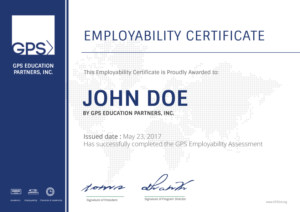
A GPS Employability Certificate is an acknowledgement that a student demonstrates that they are both 1) employable and 2) college and career ready.

Any student that is on course to graduate from our program, having completed all the necessary elements of their customized/personalized learning pathway AND has fulfilled all the GPS Employability Certificate Requirements (below), may apply.

What is the Purpose of a GPS Employability Certificate?

The GPS Employability Certificate program reinforces GPS Education Partners’ commitment to developing young men and women with Employability skills who are also College & Career Ready in an effort to enable them to flourish in a competitive, fast-moving economy.

The GPS Employability Certificate recognizes students who have graduated from the GPS program and have now completed a set of achievements (i.e. they possess skills, understandings, and personal attributes) that make them more likely to gain employment as well as be successful in their chosen occupations, which benefits themselves, the workforce, the community, and the economy. These students are also college and career ready and have the knowledge and skills in English and mathematics necessary to qualify for and succeed in entry-level, credit-bearing postsecondary coursework without the need for remediation.

[/su_tab]

[su_tab title=”Application”][su_frame align=”right”]certificate-employability-blue[/su_frame]

Application

A student applying for either an Employability, Career Pathway, and/or Leadership Certificate will need to complete an online application. [sample application]

The student will also need to submit the following:

  • Cover letter
  • Resume

[/su_tab]

[su_tab title=”References”][su_frame align=”right”]certificate-employability-blue[/su_frame]

Personal References

A student applying for either an Employability, Career Pathway, and/or Leadership Certificate will need to provide three (3) personal references who will also submit a survey on behalf of the student. [sample survey]

[/su_tab]

[su_tab title=”Portfolio”][su_frame align=”right”]certificate-employability-blue[/su_frame]

Portfolio

A student applying for either an Employability, Career Pathway, and/or Leadership Certificate will need to complete an Employment Portfolio [sample rubric]

  • Need to connect with Amanda to see if student’s already create a comprehensive portfolio in the LMS or elsewhere?

[/su_tab]


[su_tab title=”Scorecards”][su_frame align=”right”]certificate-employability-blue[/su_frame]

Scorecards

A student applying for either an Employability, Career Pathway, and/or Leadership Certificate will need scorecards that trend upwards and/or maintain an average score for the last grading period (e.g. Average score of 2.5+, 3+, and 3.5+ respectively for the last quarter).

  • Need to socialize the idea of scorecard data to determine best approach.

[/su_tab]

[su_tab title=”Assessments”][su_frame align=”right”]certificate-employability-blue[/su_frame]

Assessments

A student applying for either an Employability, Career Pathway, and/or Leadership Certificate will need to complete one of the following assessments.

Here are four (4) different types of tools to help students assess their own employability skills.

  • Self-assessments (using nudge theory)
  • Download a sample of an Employability Skills Inventory Assessment Worksheet
  • Download a sample of an Employability Skills Inventory Assessment Checklist
  • Joel’s Employability Transferable Skills Inventory/Checklist
  • Trish’s GPS Student Review Format

[/su_tab]

[su_tab title=”Credentials”][su_frame align=”right”]certificate-employability-blue[/su_frame]

Stackable Credentials

A student applying for either an Employability, Career Pathway, and/or Leadership Certificate will need to earn the following pre-requisite credentials:

Diploma – Upon completion, students will receive a high school diploma from their home high school along with a certificate of occupational proficiency in manufacturing from Wisconsin’s Department of Workforce Development.  In addition, the students will have the opportunity to become certified production technicians through the Manufacturing Skills Standards Council.  The students will also have on-the-job training and work experience highlighted in a professional portfolio.

ACT NCRC Rating – The National Career Readiness Certificate examination assesses an individual’s skill level in three areas deemed critical for employability: Reading for Information, Applied Mathematics, and Locating Information. ACT, the organization that developed the college testing standard, researched over 16,000 occupations before developing these three WorkKeys® assessments for the NCRC.

  • Only the diploma and the ACT NCRC need to be required here. The DWD YA Certificate is only applicable in Wisconsin and the MSSC CPT is a GPS Career Pathway Certificate requirement.

[/su_tab]

[su_tab title=”Reflections”][su_frame align=”right”]certificate-employability-blue[/su_frame]

Reflections

A student applying for either an Employability, Career Pathway, and/or Leadership Certificate will need to complete an Employability Reflection project (to be determined).

  • Need to connect with Amanda to see if student’s already complete any employability reflection projects in the LMS or elsewhere?

[/su_tab]


[su_tab title=”Other”][su_frame align=”right”]certificate-employability-blue[/su_frame]

Other Considerations

Insert other considerations here.

[/su_tab]

[/su_tabs]

GPS LEADERSHIP CERTIFICATE

[su_tabs]

[su_tab title=”GPS Leadership Certificate”][su_frame align=”right”]certificate-employability-blue[/su_frame]
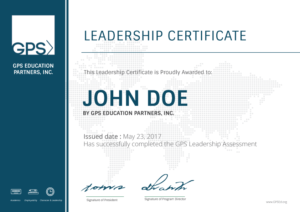
What is Leadership?

Depending on which author you read, there are many different definitions of the term ‘leadership’. This is due to the author’s predisposition to leadership as well as their intended expression (i.e. style) and outcome (i.e. vision). For example, here are the five (5) most widely used expressions and outcomes of leadership:

  • Leadership as Influence
  • Leadership as Change
  • Leadership as Service
  • Leadership as Character
  • Leadership as Development

Dr. Tim Elmore, world-renowned leadership expert, president of GrowingLeaders.com, and author of our character and leadership curriculum – The Habitudes® System, defines leadership as “the ability to influence” by “solving problems and serving people.”

What is a GPS Leadership Certificate?

A GPS Leadership Certificate is an acknowledgement that a student has the ability to influence others and desires to continue learning how to solve problems and serve people. This process involves completing an additional amount of customized/personalized “work” beyond the scope of our general graduation requirements.

Any student that is on course to graduate from our program, having completed all the necessary elements of their customized/personalized learning pathway AND has fulfilled the GPS Leadership Certificate Requirements (below), may apply.

What is the Purpose of a GPS Leadership Certificate?

The GPS Leadership Certificate program reinforces GPS Education Partners’ commitment to developing young men and women who actively pursue opportunities to improve their leadership skills beyond graduation.

The GPS Leadership Certificate recognizes students who have been endorsed by other reputable leaders who believe the student has adequately demonstrated the desire to continually develop their leadership skills by influencing others, solving problems and serving people.

[/su_tab]

[su_tab title=”Character Witnesses”][su_frame align=”right”]certificate-employability-blue[/su_frame]

Character Witnesses

A student applying for either an Employability, Career Pathway, and/or Leadership Certificate will need to provide four (4) character witnesses from the following places:

  • One (1) reference from home (e.g. parent)
  • One (1) reference from school (e.g. staff)
  • One (1) reference from work (e.g. mentor/coach)
  • One (1) reference from the community (e.g. community service learning contact)

Character witnesses will complete online surveys on behalf of the student. [sample survey]

[/su_tab]

[su_tab title=”Project”][su_frame align=”right”]certificate-employability-blue[/su_frame]

Project

A student applying for a Leadership Certificate will need to complete a leadership project (to be determined).

Ideas for a project may include:

  • Community service learning hours and complete a project
  • Read a leadership book and complete a project
  • Need to connect with Amanda to see if student’s already complete any leadership projects in the LMS or elsewhere?

[/su_tab]

[su_tab title=”Habitudes®”][su_frame align=”right”]general_habitudes-completion-certificate[/su_frame]
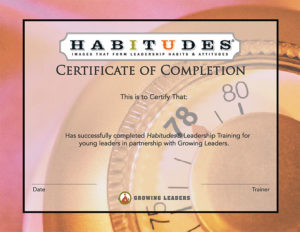
The Habitudes® System

Completion of core Habitudes® lessons OR completion of a Habitudes® 3-Credit Course.

  • Growing Leaders Habitudes® Course Syllabus Memorandum of Understanding (Download).
  • Needs to be socialized.

[/su_tab]

[su_tab title=”Credentials”][su_frame align=”right”]certificate-employability-blue[/su_frame]

Stackable Credentials

A student applying for either a Career Pathway and/or Leadership Certificate will need to earn the following pre-requisite credentials:

MSSC CPT – The CPT Certification addresses the core technical competencies of higher skilled production workers in all sectors of manufacturing.  MSSC awards certificates to individuals who pass any of its Production Modules: Safety; Quality Practices & Measurement; Manufacturing Processes & Production; Maintenance Awareness; and Green Production and a full Certified Production Technician (CPT) Certification to those who pass all four original modules (NOTE: At this time, Green is not a requirement for full CPT certification).  Following accreditation by the American National Standards Institute in December 2011, under ISO Standard 17024, the MSSC initiated a new CPT with an “AE” designation which stands for “ANSI Edition.”

  • Additional credentials earned through other post-secondary education, certifications, etc. will also be worthy of consideration towards earning a GPS Employability Certificate and/or a GPS Leadership/Citizenship Certificate.

[/su_tab]

[su_tab title=”Reflections”][su_frame align=”right”]certificate-employability-blue[/su_frame]

Reflections

A student applying for a Leadership Certificate will need to complete an Leadership Reflection project (to be determined).

  • Need to connect with Amanda to see if student’s already complete any leadership reflection projects in the LMS or elsewhere?

[/su_tab]


[su_tab title=”Other”][su_frame align=”right”]certificate-employability-blue[/su_frame]

Other Considerations

Insert other considerations here.

[/su_tab]

[/su_tabs]

Side-by-Side Comparison of Certificate Requirements Checklist

[easy-pricing-table id=”2484″]

Super Skills & Competencies (Mapped to Model Standards & CCR)

Super Skills
Educational Outcomes
1. Readiness.

Students continually seek opportunities to learn, own, and apply what they’ve learned in an effort to become better learners.


Level 1: Academic Domain

2. Reliability.

Students continually explore their own values and beliefs with integrity and purpose.


Level 1: Social & Emotional Domain

3. Respectful.

Students continually demonstrate their commitment to becoming the best versions of themselves. They trust and respect the process as well as those around them.


Level 1: Character & Leadership Domain

4. Resourceful.

Students continually demonstrate their ability to be thorough and resourceful, to expand their thinking, and to learn from others.


Level 2: Academic Domain

5. Relational.

Students continually adjust and adapt to changing circumstances placing an emphasis on relationship building understanding how individual differences affect group processes.


Level 2: Social & Emotional Domain

6. Responsibility.

Students continually take responsibility for personal actions and act ethically.


Level 2: Character & Leadership Domain

7. Resolute.

Students continually demonstrate the ability to employ critical and creating thinking skills to solve problems and make rational, ethical, and effective decisions that produce the best possible result.


Level 3: Academic Domain

8. Resilience.

Students continually demonstrate and seek to enhance the values, skills, and traits that increase their ability to build healthy relationships while the successful achievement of their academic, personal, and professional goals increases the value they bring to each of those relationships.


Level 3: Social & Emotional Domain

9. Relevant.

Students demonstrate good citizenship by fulfilling their social and civic responsibilities. They contribute to the well-being of every community in which they live (i.e. home, school, work, community, etc.)


Level 3: Character & Leadership Domain

Academic
Academic
Click to View Competencies

A1. Motivated and Committed Learners
A1.1. Curiosity
A1.2. Personal Growth and Lifelong Learning
A2. Confident and Diligent Learners
A2.1. Growth Mindset
A2.2. Learning From Mistakes
A3. Responsible, Engaged, Autonomous, and Connected Learners
A3.1. Dedication to Education
A3.2. Full Engagement in Learning Process
A3.3. Self-Directed Learners
A3.4. Resourceful, Discerning Researchers
A3.5. Versatile Learners
A3.6. Connection to School Community
A4. Knowledgeable, Logical, Critical and Creative Thinkers
A4.1. Acquire, Remember Knowledge
A4.2. Understand Knowledge
A4.3. Apply Knowledge
A4.4. Analyze, Evaluate (Critical Thinking)
A4.5. Create, Innovate (Synthesis)
A4.6. Concentrate
A4.7. Perceptive, Observant
A4.8. Openness
A4.9. Intellectual Integrity
A4.10. Intellectual Independence
A4.11. Intellectual Humility
A4.12. Pursuit of Wisdom
A5. Effective Problem Solvers and Decision Makers
A5.1. Rational Decision Making
A5.2. Ethical Decision Making
A5.3. Effective Decision Making
A5.4. Best Possible Result

+ CCR Competencies

CCR 1: Acquire the self-knowledge necessary to make informed career decisions.
CCR 2: Understand the relationship between educational achievement and career development.
CCR 3: Employ career management strategies to achieve future career success.
CCR 4: Demonstrates the ability to fulfill training or certification requirements for employment
CCR 5: Sets and implements personal goals for improvement.

Click to View Competencies

A3.2. Full Engagement in Learning Process
A4.1. Acquire, Remember Knowledge
A4.2. Understand Knowledge
A4.3. Apply Knowledge
A4.4. Analyze, Evaluate (Critical Thinking)
A4.5. Create, Innovate (Synthesis)
A4.7. Perceptive, Observant
A4.8. Openness
A4.9. Intellectual Integrity
A4.12. Pursuit of Wisdom
A5. Effective Problem Solvers and Decision Makers
A5.2. Ethical Decision Making
A5.4. Best Possible Result

+ CCR Competencies

CCR 1: Acquire the self-knowledge necessary to make informed career decisions.
CCR 4: Demonstrates the ability to fulfill training or certification requirements for employment

Click to View Competencies

A4.6. Concentrate
A4.9. Intellectual Integrity
A4.11. Intellectual Humility
A4.12. Pursuit of Wisdom
A5. Effective Problem Solvers and Decision Makers
A5.2. Ethical Decision Making
A5.3. Effective Decision Making
A5.4. Best Possible Result

Click to View Competencies

A1. Motivated and Committed Learners
A1.1. Curiosity
A1.2. Personal Growth and Lifelong Learning
A2. Confident and Diligent Learners
A2.1. Growth Mindset
A2.2. Learning From Mistakes
A3. Responsible, Engaged, Autonomous, and Connected Learners
A3.1. Dedication to Education
A3.2. Full Engagement in Learning Process
A3.3. Self-Directed Learners
A3.4. Resourceful, Discerning Researchers
A3.5. Versatile Learners
A3.6. Connection to School Community
A4. Knowledgeable, Logical, Critical and Creative Thinkers
A4.1. Acquire, Remember Knowledge
A4.2. Understand Knowledge
A4.3. Apply Knowledge
A4.4. Analyze, Evaluate (Critical Thinking)
A4.5. Create, Innovate (Synthesis)
A4.6. Concentrate
A4.7. Perceptive, Observant
A4.8. Openness
A4.9. Intellectual Integrity
A4.10. Intellectual Independence
A4.11. Intellectual Humility
A4.12. Pursuit of Wisdom
A5. Effective Problem Solvers and Decision Makers
A5.1. Rational Decision Making
A5.2. Ethical Decision Making
A5.3. Effective Decision Making
A5.4. Best Possible Result

+ CCR Competencies

CCR 1: Acquire the self-knowledge necessary to make informed career decisions.
CCR 3: Employ career management strategies to achieve future career success.
CCR 4: Demonstrates the ability to fulfill training or certification requirements for employment

Click to View Competencies

A3.6. Connection to School Community
A4.6. Concentrate
A4.9. Intellectual Integrity
A4.12. Pursuit of Wisdom
A5. Effective Problem Solvers and Decision Makers
A5.1. Rational Decision Making
A5.2. Ethical Decision Making
A5.4. Best Possible Result

Click to View Competencies

A2.2. Learning From Mistakes
A3.5. Versatile Learners
A4. Knowledgeable, Logical, Critical and Creative Thinkers
A4.4. Analyze, Evaluate (Critical Thinking)
A4.5. Create, Innovate (Synthesis)
A4.8. Openness
A4.9. Intellectual Integrity
A4.10. Intellectual Independence
A4.12. Pursuit of Wisdom
A5. Effective Problem Solvers and Decision Makers
A5.1. Rational Decision Making
A5.2. Ethical Decision Making

+ CCR Competencies

CCR 1: Acquire the self-knowledge necessary to make informed career decisions.
CCR 3: Employ career management strategies to achieve future career success.
CCR 4: Demonstrates the ability to fulfill training or certification requirements for employment
CCR 5: Sets and implements personal goals for improvement.

Click to View Competencies
A1. Motivated and Committed Learners
A1.2. Personal Growth and Lifelong Learning
A2.2. Learning From Mistakes
A3.2. Full Engagement in Learning Process
A4. Knowledgeable, Logical, Critical and Creative Thinkers
A4.5. Create, Innovate (Synthesis)
A4.9. Intellectual Integrity
A4.10. Intellectual Independence
A4.12. Pursuit of Wisdom
A5. Effective Problem Solvers and Decision Makers
A5.1. Rational Decision Making
A5.2. Ethical Decision Making
 
+ CCR Competencies
 
CCR 1: Acquire the self-knowledge necessary to make informed career decisions.

CCR 2: Understand the relationship between educational achievement and career development.
CCR 3: Employ career management strategies to achieve future career success.
CCR 4: Demonstrates the ability to fulfill training or certification requirements for employment
CCR 5: Sets and implements personal goals for improvement.

Click to View Competencies

A2.2. Learning From Mistakes
A3.5. Versatile Learners
A4. Knowledgeable, Logical, Critical and Creative Thinkers
A4.4. Analyze, Evaluate (Critical Thinking)
A4.5. Create, Innovate (Synthesis)
A4.8. Openness
A4.9. Intellectual Integrity
A4.10. Intellectual Independence
A4.12. Pursuit of Wisdom
A5. Effective Problem Solvers and Decision Makers
A5.1. Rational Decision Making
A5.2. Ethical Decision Making

Click to View Competencies
A1. Motivated and Committed Learners
A1.1. Curiosity
A1.2. Personal Growth and Lifelong Learning
A2. Confident and Diligent Learners
A2.1. Growth Mindset
A2.2. Learning From Mistakes
A3. Responsible, Engaged, Autonomous, and Connected Learners
A3.1. Dedication to Education
A3.2. Full Engagement in Learning Process
A3.3. Self-Directed Learners
A3.4. Resourceful, Discerning Researchers
A3.5. Versatile Learners
A3.6. Connection to School Community
A4. Knowledgeable, Logical, Critical and Creative Thinkers
A4.1. Acquire, Remember Knowledge
A4.2. Understand Knowledge
A4.3. Apply Knowledge
A4.4. Analyze, Evaluate (Critical Thinking)
A4.5. Create, Innovate (Synthesis)
A4.6. Concentrate
A4.7. Perceptive, Observant
A4.8. Openness
A4.9. Intellectual Integrity
A4.10. Intellectual Independence
A4.11. Intellectual Humility
A4.12. Pursuit of Wisdom
A5. Effective Problem Solvers and Decision Makers
A5.1. Rational Decision Making
A5.2. Ethical Decision Making
A5.3. Effective Decision Making
A5.4. Best Possible Result
Social & Emotional
Social & Emotional
Click to View Competencies


SE1. Self-Awareness
SE1.1. Emotions and Their Impact
SE1.4. Self-Acceptance
SE1.5. Concept of Happiness and Success
SE2. Self-Management
SE2.1. Expressing Emotions
SE2.2. Self-Discipline
SE2.3. Managing Stress, Anxiety, Depression, and Other Negative Emotions
SE2.4. Resilience and Courage
SE2.5. Flexibility
SE2.6. Patience and Poise
SE2.7. Self-Improvement
SE2.10. Managing Time
SE3.3. Remorse
SE3.4. Positive Relationships
SE3.6. Leadership
SE3.7. Collaboration and Teamwork
SE3.8. Conflict Management
SE4. Success Skills and Attitudes
SE4.1. Executive Function
SE4.2. Commitment to Excellence
SE4.3. Conscientiousness
SE4.4. Perseverance
SE4.5. Self-Confidence
SE4.6. Self-Motivation and Action
SE4.7. Positivity
SE4.10. Technological Literacy
SE4.11. Financial Literacy

Click to View Competencies


SE1. Self-Awareness
SE1.1. Emotions and Their Impact
SE1.2. Traits and Attributes
SE1.3. Values, Beliefs, Attitudes, Mindsets
SE1.5. Concept of Happiness and Success
SE2. Self-Management
SE2.1. Expressing Emotions
SE2.2. Self-Discipline
SE2.3. Managing Stress, Anxiety, Depression, and Other Negative Emotions
SE2.4. Resilience and Courage
SE2.6. Patience and Poise
SE2.7. Self-Improvement
SE2.8. Setting Goals
SE2.9. Planning
SE2.10. Managing Time
SE2.11. Organization
SE3.3. Remorse
SE3.4. Positive Relationships
SE3.5. Effective Communication
SE3.7. Collaboration and Teamwork
SE3.8. Conflict Management
SE4. Success Skills and Attitudes
SE4.2. Commitment to Excellence
SE4.3. Conscientiousness
SE4.4. Perseverance
SE4.5. Self-Confidence
SE4.6. Self-Motivation and Action
SE4.7. Positivity
SE4.8. Gratitude
SE4.9. Forgiveness
SE4.11. Financial Literacy

Click to View Competencies


SE1.5. Concept of Happiness and Success
SE2. Self-Management
SE2.1. Expressing Emotions
SE2.2. Self-Discipline
SE2.3. Managing Stress, Anxiety, Depression, and Other Negative Emotions
SE2.6. Patience and Poise
SE2.7. Self-Improvement
SE3. Social Awareness and Relationship Skills and Traits
SE3.1. Social Awareness
SE3.2. Empathy
SE3.3. Remorse
SE3.4. Positive Relationships
SE3.5. Effective Communication
SE3.7. Collaboration and Teamwork
SE3.8. Conflict Management
SE4. Success Skills and Attitudes
SE4.2. Commitment to Excellence
SE4.5. Self-Confidence
SE4.6. Self-Motivation and Action
SE4.7. Positivity
SE4.8. Gratitude
SE4.9. Forgiveness

Click to View Competencies


SE1. Self-Awareness
SE1.1. Emotions and Their Impact
SE1.2. Traits and Attributes
SE1.3. Values, Beliefs, Attitudes, Mindsets
SE1.4. Self-Acceptance
SE1.5. Concept of Happiness and Success
SE2. Self-Management
SE2.1. Expressing Emotions
SE2.2. Self-Discipline
SE2.3. Managing Stress, Anxiety, Depression, and Other Negative Emotions
SE2.4. Resilience and Courage
SE2.5. Flexibility
SE2.7. Self-Improvement
SE2.8. Setting Goals
SE2.9. Planning
SE2.11. Organization
SE3. Social Awareness and Relationship Skills and Traits
SE3.1. Social Awareness
SE3.2. Empathy
SE3.3. Remorse
SE3.4. Positive Relationships
SE3.5. Effective Communication
SE3.6. Leadership
SE3.7. Collaboration and Teamwork
SE3.8. Conflict Management
SE4. Success Skills and Attitudes
SE4.1. Executive Function
SE4.2. Commitment to Excellence
SE4.3. Conscientiousness
SE4.4. Perseverance
SE4.5. Self-Confidence
SE4.6. Self-Motivation and Action
SE4.7. Positivity
SE4.8. Gratitude
SE4.9. Forgiveness
SE4.10. Technological Literacy
SE4.11. Financial Literacy

Click to View Competencies

SE1.4. Self-Acceptance
SE1.5. Concept of Happiness and Success
SE1.6. Capacity to Be a Change Agent
SE2.1. Expressing Emotions
SE2.2. Self-Discipline
SE2.3. Managing Stress, Anxiety, Depression, and Other Negative Emotions
SE2.7. Self-Improvement
SE3. Social Awareness and Relationship Skills and Traits
SE3.1. Social Awareness
SE3.2. Empathy
SE3.3. Remorse
SE3.4. Positive Relationships
SE3.5. Effective Communication
SE3.6. Leadership
SE3.7. Collaboration and Teamwork
SE3.8. Conflict Management
SE4. Success Skills and Attitudes
SE4.1. Executive Function
SE4.2. Commitment to Excellence
SE4.5. Self-Confidence
SE4.6. Self-Motivation and Action
SE4.7. Positivity
SE4.8. Gratitude
SE4.9. Forgiveness
SE4.10. Technological Literacy
SE4.11. Financial Literacy

Click to View Competencies


SE1. Self-Awareness
SE1.1. Emotions and Their Impact
SE1.2. Traits and Attributes
SE1.3. Values, Beliefs, Attitudes, Mindsets
SE1.4. Self-Acceptance
SE1.5. Concept of Happiness and Success
SE2. Self-Management
SE2.1. Expressing Emotions
SE2.2. Self-Discipline
SE2.3. Managing Stress, Anxiety, Depression, and Other Negative Emotions
SE2.4. Resilience and Courage
SE2.5. Flexibility
SE2.6. Patience and Poise
SE2.7. Self-Improvement
SE2.8. Setting Goals
SE2.9. Planning
SE3.8. Conflict Management
SE4. Success Skills and Attitudes
SE4.1. Executive Function
SE4.2. Commitment to Excellence
SE4.3. Conscientiousness
SE4.4. Perseverance
SE4.5. Self-Confidence
SE4.6. Self-Motivation and Action
SE4.7. Positivity
SE4.9. Forgiveness
Click to View Competencies
 
SE1. Self-Awareness
SE1.2. Traits and Attributes
SE1.3. Values, Beliefs, Attitudes, Mindsets
SE1.4. Self-Acceptance
SE1.5. Concept of Happiness and Success
SE1.6. Capacity to Be a Change Agent
SE2. Self-Management
SE2.1. Expressing Emotions
SE2.2. Self-Discipline
SE2.3. Managing Stress, Anxiety, Depression, and Other Negative Emotions
SE2.4. Resilience and Courage
SE2.5. Flexibility
SE2.6. Patience and Poise
SE2.7. Self-Improvement
SE2.8. Setting Goals
SE2.9. Planning
SE2.10. Managing Time
SE2.11. Organization
SE3.6. Leadership
SE3.8. Conflict Management
SE4. Success Skills and Attitudes
SE4.2. Commitment to Excellence
SE4.3. Conscientiousness
SE4.4. Perseverance
SE4.5. Self-Confidence
SE4.6. Self-Motivation and Action
SE4.7. Positivity
SE4.11. Financial Literacy
Click to View Competencies

SE1. Self-Awareness
SE1.1. Emotions and Their Impact
SE1.2. Traits and Attributes
SE1.3. Values, Beliefs, Attitudes, Mindsets
SE1.4. Self-Acceptance
SE1.5. Concept of Happiness and Success
SE2. Self-Management
SE2.1. Expressing Emotions
SE2.2. Self-Discipline
SE2.3. Managing Stress, Anxiety, Depression, and Other Negative Emotions
SE2.4. Resilience and Courage
SE2.5. Flexibility
SE2.6. Patience and Poise
SE2.7. Self-Improvement
SE2.8. Setting Goals
SE2.9. Planning
SE3.8. Conflict Management
SE4. Success Skills and Attitudes
SE4.1. Executive Function
SE4.2. Commitment to Excellence
SE4.3. Conscientiousness
SE4.4. Perseverance
SE4.5. Self-Confidence
SE4.6. Self-Motivation and Action
SE4.7. Positivity
SE4.9. Forgiveness

Click to View Competencies


SE1.4. Self-Acceptance
SE1.5. Concept of Happiness and Success
SE1.6. Capacity to Be a Change Agent
SE2.1. Expressing Emotions
SE2.2. Self-Discipline
SE2.3. Managing Stress, Anxiety, Depression, and Other Negative Emotions
SE2.7. Self-Improvement
SE3. Social Awareness and Relationship Skills and Traits
SE3.1. Social Awareness
SE3.3. Remorse
SE3.4. Positive Relationships
SE3.5. Effective Communication
SE3.6. Leadership
SE3.7. Collaboration and Teamwork
SE3.8. Conflict Management
SE4. Success Skills and Attitudes
SE4.1. Executive Function
SE4.2. Commitment to Excellence
SE4.5. Self-Confidence
SE4.6. Self-Motivation and Action
SE4.7. Positivity
SE4.8. Gratitude
SE4.9. Forgiveness
SE4.10. Technological Literacy
SE4.11. Financial Literacy
Character & Leadership
Click to View Competencies


C1. Commitment to Character and Ethics
C1.1. Good Character – Components
C1.2. Importance of Character
C1.3. Responsibility for Character
C1.4. The Six Pillars of Character
C2. Trustworthiness
C2.1. Integrity
C2.3. Honest Actions
C2.5. Promise-Keeping & Reliability
C3.3. The Basics of Respect
C4. Responsibility
C4.1. Compliance: Doing What Is Required
C4.2. Ethics: Doing What Should Be Done
C4.3. Consequences for Their Words
C4.4. Consequences for Actions
C4.5. Developing and Using Positive Attitudes and Life Skills
C4.7. Learning From Experience
C7. Good Citizenship
C7.2. Civil Responsibilities
C7.3 Respect for Authority & Law
C7.4. Participation in Democratic Process
C7.5. Improving School Climate

Click to View Competencies


C1. Commitment to Character and Ethics
C1.1. Good Character – Components
C1.2. Importance of Character
C1.3. Responsibility for Character
C1.4. The Six Pillars of Character
C1.5. Ethical Concepts and Terms
C2. Trustworthiness
C2.1. Integrity
C2.2. Honest Communications
C2.3. Honest Actions
C2.4. Belief That Honesty Pays
C2.5. Promise-Keeping & Reliability
C2.6. Loyalty
C3. Respect
C3.1. Treating Others With Respect
C3.2. The Golden Rule
C3.3. The Basics of Respect
C3.5. Respecting Privacy
C3.6. Respecting Others’ Autonomy
C4. Responsibility
C4.1. Compliance: Doing What Is Required
C4.2. Ethics: Doing What Should Be Done
C4.3. Consequences for Their Words
C4.4. Consequences for Actions
C4.5. Developing and Using Positive Attitudes and Life Skills
C4.6. Self-Reliance and Prudent Money Management
C4.7. Learning From Experience
C4.8. Being Rational and Reflective
C4.9. Healthy Choices
C5. Fairness
C5.1. The Basics of Fairness
C5.2. Making Fair Decisions
C5.3. Proportionality
C5.4. Complexity of Fairness
C6. Caring
C6.1. The Basics of Caring
C6.2. Caring & Other Ethical Duties
C7. Good Citizenship
C7.1. Civil Rights
C7.2. Civil Responsibilities
C7.3 Respect for Authority & Law
C7.4. Participation in Democratic Process
C7.5. Improving School Climate
C7.6. Environmental Protection

Click to View Competencies


C1. Commitment to Character and Ethics
C1.1. Good Character – Components
C1.2. Importance of Character
C1.3. Responsibility for Character
C1.4. The Six Pillars of Character
C1.5. Ethical Concepts and Terms
C2. Trustworthiness
C2.1. Integrity
C2.2. Honest Communications
C2.3. Honest Actions
C2.4. Belief That Honesty Pays
C2.5. Promise-Keeping & Reliability
C2.6. Loyalty
C3. Respect
C3.1. Treating Others With Respect
C3.2. The Golden Rule
C3.3. The Basics of Respect
C3.4. School Climate
C3.5. Respecting Privacy
C3.6. Respecting Others’ Autonomy
C4. Responsibility
C4.1. Compliance: Doing What Is Required
C4.2. Ethics: Doing What Should Be Done
C4.3. Consequences for Their Words
C4.4. Consequences for Actions
C4.5. Developing and Using Positive Attitudes and Life Skills
C4.7. Learning From Experience
C5. Fairness
C5.1. The Basics of Fairness
C5.2. Making Fair Decisions
C5.3. Proportionality
C5.4. Complexity of Fairness
C6. Caring
C6.1. The Basics of Caring
C6.2. Caring & Other Ethical Duties
C7. Good Citizenship
C7.1. Civil Rights
C7.2. Civil Responsibilities
C7.3 Respect for Authority & Law
C7.4. Participation in Democratic Process
C7.5. Improving School Climate
C7.6. Environmental Protection

Click to View Competencies


C1. Commitment to Character and Ethics
C1.1. Good Character – Components
C1.2. Importance of Character
C1.3. Responsibility for Character
C1.4. The Six Pillars of Character
C1.5. Ethical Concepts and Terms
C2. Trustworthiness
C2.1. Integrity
C2.2. Honest Communications
C2.4. Belief That Honesty Pays
C2.5. Promise-Keeping & Reliability
C3. Respect
C3.1. Treating Others With Respect
C3.2. The Golden Rule
C3.3. The Basics of Respect
C4. Responsibility
C4.1. Compliance: Doing What Is Required
C4.2. Ethics: Doing What Should Be Done
C4.3. Consequences for Their Words
C4.4. Consequences for Actions
C4.5. Developing and Using Positive Attitudes and Life Skills
C4.6. Self-Reliance and Prudent Money Management
C4.7. Learning From Experience
C4.8. Being Rational and Reflective
C4.9. Healthy Choices
C5. Fairness
C5.1. The Basics of Fairness
C5.2. Making Fair Decisions
C5.3. Proportionality
C5.4. Complexity of Fairness
C6. Caring
C7. Good Citizenship
C7.4. Participation in Democratic Process
C7.5. Improving School Climate

Click to View Competencies

C1. Commitment to Character and Ethics
C1.1. Good Character – Components
C1.2. Importance of Character
C1.3. Responsibility for Character
C1.4. The Six Pillars of Character
C2. Trustworthiness
C2.1. Integrity
C2.2. Honest Communications
C2.3. Honest Actions
C2.4. Belief That Honesty Pays
C2.5. Promise-Keeping & Reliability
C2.6. Loyalty
C3. Respect
C3.1. Treating Others With Respect
C3.2. The Golden Rule
C3.3. The Basics of Respect
C3.4. School Climate
C3.5. Respecting Privacy
C3.6. Respecting Others’ Autonomy
C4. Responsibility
C4.1. Compliance: Doing What Is Required
C4.2. Ethics: Doing What Should Be Done
C4.3. Consequences for Their Words
C4.4. Consequences for Actions
C4.5. Developing and Using Positive Attitudes and Life Skills
C4.7. Learning From Experience
C5. Fairness
C5.1. The Basics of Fairness
C5.2. Making Fair Decisions
C5.3. Proportionality
C6. Caring
C6.1. The Basics of Caring
C6.2. Caring & Other Ethical Duties
C7. Good Citizenship
C7.2. Civil Responsibilities
C7.3 Respect for Authority & Law
C7.4. Participation in Democratic Process
C7.5. Improving School Climate
C7.6. Environmental Protection

Click to View Competencies


C1. Commitment to Character and Ethics
C1.1. Good Character – Components
C1.2. Importance of Character
C1.3. Responsibility for Character
C1.4. The Six Pillars of Character
C2. Trustworthiness
C2.1. Integrity
C2.5. Promise-Keeping & Reliability
C3.3. The Basics of Respect
C4. Responsibility
C4.1. Compliance: Doing What Is Required
C4.2. Ethics: Doing What Should Be Done
C4.3. Consequences for Their Words
C4.4. Consequences for Actions
C4.5. Developing and Using Positive Attitudes and Life Skills
C4.6. Self-Reliance and Prudent Money Management
C4.7. Learning From Experience
C4.8. Being Rational and Reflective
C4.9. Healthy Choices
C5.3. Proportionality
C5.4. Complexity of Fairness
C7. Good Citizenship
C7.4. Participation in Democratic Process
C7.5. Improving School Climate

Click to View Competencies
 
C1. Commitment to Character and Ethics
C1.1. Good Character – Components
C1.2. Importance of Character
C1.3. Responsibility for Character
C1.4. The Six Pillars of Character
C2. Trustworthiness
C2.1. Integrity
C2.5. Promise-Keeping & Reliability
C3.3. The Basics of Respect
C4. Responsibility
C4.1. Compliance: Doing What Is Required
C4.2. Ethics: Doing What Should Be Done
C4.3. Consequences for Their Words
C4.4. Consequences for Actions
C4.5. Developing and Using Positive Attitudes and Life Skills
C4.6. Self-Reliance and Prudent Money Management
C4.7. Learning From Experience
C4.8. Being Rational and Reflective
C4.9. Healthy Choices
C7. Good Citizenship
C7.4. Participation in Democratic Process
Click to View Competencies

C1. Commitment to Character and Ethics
C1.1. Good Character – Components
C1.2. Importance of Character
C1.3. Responsibility for Character
C1.4. The Six Pillars of Character
C2. Trustworthiness
C2.1. Integrity
C2.5. Promise-Keeping & Reliability
C3.3. The Basics of Respect
C4. Responsibility
C4.1. Compliance: Doing What Is Required
C4.2. Ethics: Doing What Should Be Done
C4.3. Consequences for Their Words
C4.4. Consequences for Actions
C4.5. Developing and Using Positive Attitudes and Life Skills
C4.6. Self-Reliance and Prudent Money Management
C4.7. Learning From Experience
C4.8. Being Rational and Reflective
C4.9. Healthy Choices
C5.3. Proportionality
C5.4. Complexity of Fairness
C7. Good Citizenship
C7.4. Participation in Democratic Process
C7.5. Improving School Climate

Click to View Competencies

C1. Commitment to Character and Ethics
C1.1. Good Character – Components
C1.2. Importance of Character
C1.3. Responsibility for Character
C1.4. The Six Pillars of Character
C1.5. Ethical Concepts and Terms
C2. Trustworthiness
C2.1. Integrity
C2.2. Honest Communications
C2.4. Belief That Honesty Pays
C2.5. Promise-Keeping & Reliability
C2.6. Loyalty
C3. Respect
C3.1. Treating Others With Respect
C3.2. The Golden Rule
C3.3. The Basics of Respect
C3.4. School Climate
C4. Responsibility
C4.1. Compliance: Doing What Is Required
C4.2. Ethics: Doing What Should Be Done
C4.3. Consequences for Their Words
C4.4. Consequences for Actions
C4.5. Developing and Using Positive Attitudes and Life Skills
C4.6. Self-Reliance and Prudent Money Management
C4.7. Learning From Experience
C5. Fairness
C5.1. The Basics of Fairness
C5.2. Making Fair Decisions
C5.3. Proportionality
C6. Caring
C6.1. The Basics of Caring
C6.2. Caring & Other Ethical Duties
C7. Good Citizenship
C7.1. Civil Rights
C7.2. Civil Responsibilities
C7.3 Respect for Authority & Law
C7.4. Participation in Democratic Process
C7.5. Improving School Climate
C7.6. Environmental Protection

  • Yellow – Employability Progression
  • Green – College & Career Ready Progression
  • Blue – Leadership Progression

Super Statements, Pathways, and Certificate Requirements
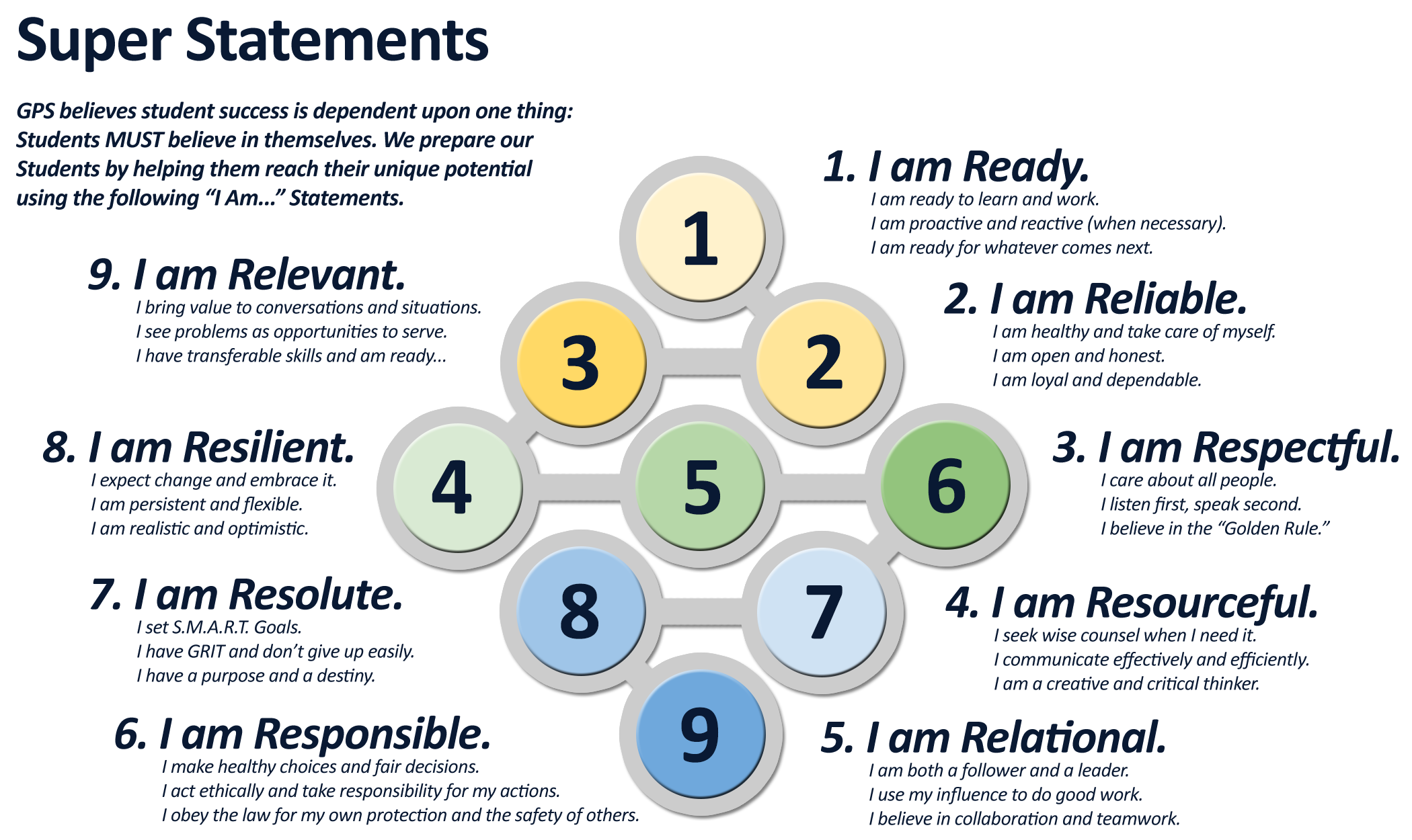
Super Statements
Super Competencies (i.e. Foundational)
1. I am Ready.
  • I am ready to learn and work.
  • I am proactive and reactive (when necessary).
  • I am ready for whatever comes next.


2. I am Reliable.
  • I am healthy and take care of myself.
  • I am open and honest.
  • I am loyal and dependable.
3. I am Respectful.
  • I care about all people.
  • I listen first, speak second.
  • I believe in the “Golden Rule.”
4. I am Resourceful.
  • I seek wise counsel when I need it.
  • I communicate effectively and efficiently.
  • I am a creative and critical thinker.
5. I am Relational.
  • I am both a follower and a leader.
  • I use my influence to do good work.
  • I believe in collaboration and teamwork.
6. I am Responsible.
  • I make healthy choices and fair decisions.
  • I act ethically and take responsibility for my actions.
  • I obey the law for my own protection and the safety of others.
7. I am Resolute.
  • I set S.M.A.R.T. goals.
  • I have GRIT and don’t give up easily.
  • I have a purpose and a destiny.
8. I am Resilient.
  • I expect change and embrace it.
  • I am persistent, yet flexible.
  • I use my strengths to overcome my weaknesses.
9. I am Relevant.
  • I add value to conversations and situations.
  • I see problems as opportunities to serve.
  • I am knowledgeable, skilled, and ready…
Pathway
Requirements
Pathway to Competence

Lessons (Examples)

  • Habitudes® Lessons
  • Capstone Projects
  • MSSC Lessons

Assessments (Examples)

  • Self-reflection Assessments
  • Rubrics
  • Quizzes/Tests
  • Employability Scorecards
  • 3rd Party Assessments (e.g. ACT, NCRC, MSSC)

Evidence (Examples)

  • LMS Grades
  • Portfolio
  • 3rd Party Credentials (ACT/NCRC/MSSC)
  • Attendance Records
  • Employability Scorecard Data
Pathway to Competence

Lessons (Examples)

  • Habitudes® Lessons
  • Capstone Projects
  • MSSC Lessons

Assessments (Examples)

  • Self-reflection Assessments
  • Rubrics
  • Quizzes/Tests
  • Employability Scorecards
  • 3rd Party Assessments (e.g. ACT, NCRC, MSSC)

Evidence (Examples)

  • LMS Grades
  • Portfolio
  • 3rd Party Credentials (ACT/NCRC/MSSC)
  • Attendance Records
  • Employability Scorecard Data
Pathway to Competence

Lessons (Examples)

  • Habitudes® Lessons
  • Capstone Projects
  • MSSC Lessons

Assessments (Examples)

  • Self-reflection Assessments
  • Rubrics
  • Quizzes/Tests
  • Employability Scorecards
  • 3rd Party Assessments (e.g. ACT, NCRC, MSSC)

Evidence (Examples)

  • LMS Grades
  • Portfolio
  • 3rd Party Credentials (ACT/NCRC/MSSC)
  • Attendance Records
  • Employability Scorecard Data
Pathway to Competence

Lessons (Examples)

  • Habitudes® Lessons
  • Capstone Projects
  • MSSC Lessons

Assessments (Examples)

  • Self-reflection Assessments
  • Rubrics
  • Quizzes/Tests
  • Employability Scorecards
  • 3rd Party Assessments (e.g. ACT, NCRC, MSSC)

Evidence (Examples)

  • LMS Grades
  • Portfolio
  • 3rd Party Credentials (ACT/NCRC/MSSC)
  • Attendance Records
  • Employability Scorecard Data
Pathway to Competence

Lessons (Examples)

  • Habitudes® Lessons
  • Capstone Projects
  • MSSC Lessons

Assessments (Examples)

  • Self-reflection Assessments
  • Rubrics
  • Quizzes/Tests
  • Employability Scorecards
  • 3rd Party Assessments (e.g. ACT, NCRC, MSSC)

Evidence (Examples)

  • LMS Grades
  • Portfolio
  • 3rd Party Credentials (ACT/NCRC/MSSC)
  • Attendance Records
  • Employability Scorecard Data
Pathway to Competence

Lessons (Examples)

  • Habitudes® Lessons
  • Capstone Projects
  • MSSC Lessons

Assessments (Examples)

  • Self-reflection Assessments
  • Rubrics
  • Quizzes/Tests
  • Employability Scorecards
  • 3rd Party Assessments (e.g. ACT, NCRC, MSSC)

Evidence (Examples)

  • LMS Grades
  • Portfolio
  • 3rd Party Credentials (ACT/NCRC/MSSC)
  • Attendance Records
  • Employability Scorecard Data
Pathway to Competence

Lessons (Examples)

  • Habitudes® Lessons
  • Capstone Projects
  • MSSC Lessons

Assessments (Examples)

  • Self-reflection Assessments
  • Rubrics
  • Quizzes/Tests
  • Employability Scorecards
  • 3rd Party Assessments (e.g. ACT, NCRC, MSSC)

Evidence (Examples)

  • LMS Grades
  • Portfolio
  • 3rd Party Credentials (ACT/NCRC/MSSC)
  • Attendance Records
  • Employability Scorecard Data
Pathway to Competence

Lessons (Examples)

  • Habitudes® Lessons
  • Capstone Projects
  • MSSC Lessons

Assessments (Examples)

  • Self-reflection Assessments
  • Rubrics
  • Quizzes/Tests
  • Employability Scorecards
  • 3rd Party Assessments (e.g. ACT, NCRC, MSSC)

Evidence (Examples)

  • LMS Grades
  • Portfolio
  • 3rd Party Credentials (ACT/NCRC/MSSC)
  • Attendance Records
  • Employability Scorecard Data
Pathway to Competence

Lessons (Examples)

  • Habitudes® Lessons
  • Capstone Projects
  • MSSC Lessons

Assessments (Examples)

  • Self-reflection Assessments
  • Rubrics
  • Quizzes/Tests
  • Employability Scorecards
  • 3rd Party Assessments (e.g. ACT, NCRC, MSSC)

Evidence (Examples)

  • LMS Grades
  • Portfolio
  • 3rd Party Credentials (ACT/NCRC/MSSC)
  • Attendance Records
  • Employability Scorecard Data
Employability
Requirements
Required

Demonstration of Competency:

  • Student demonstrates the knowledge, skills, values, and traits necessary to be ready.
  • Student demonstrates readiness by being willing to learn and work in both the classroom and the workplace.
  • Student demonstrates readiness by being proactive, active, and reactive (when necessary) in order to maintain a state of readiness.
  • Student demonstrates readiness by showing both preparedness and courage for whatever comes next.
Required

Demonstration of Competency:

  • Student demonstrates the knowledge, skills, values, and traits necessary to be reliable.
  • Student demonstrates reliability by being healthy, balanced, nourished, challenged, etc. (e.g. sun, water, sleep, diet, exercise, relationships, reading, viewing, listening, etc.).
  • Student demonstrates reliability by being both open and honest with their opinions, judgments, etc.
  • Student demonstrates reliability by being loyal and dependable with their words and actions.
Required

Demonstration of Competency:

  • Student demonstrates the knowledge, skills, values, and traits necessary to be respectful.
  • Student demonstrates respect by caring for and showing empathy for all people.
  • Student demonstrates respect by listening first and speaking second.
  • Student demonstrates respect by following the “Golden Rule” (i.e. treating others as they wish to be treated).
Required

Demonstration of Competency:

  • Student demonstrates the knowledge, skills, values, and traits necessary to be resourceful.
  • Student demonstrates resourcefulness by seeking wise counsel from wise counselors (i.e. others who have wisdom, experience, etc.)
  • Student demonstrates resourcefulness by communicating both verbally and non-verbally, effectively and efficiently.
  • Student demonstrates demonstrates resourcefulness by being both a creative and critical thinker, especially when synthesizing and integrating knowledge, skills, values, and traits.
Required

Demonstration of Competency:

  • Student demonstrates the knowledge, skills, values, and traits necessary to be relational.
  • Student demonstrates being relational by knowing who and when to follow as well as when to lead others by example.
  • Student demonstrates being relational by using influence to do good works.
  • Student demonstrates being relational by collaborating and working with others.
Required

Demonstration of Competency:

  • Student demonstrates the knowledge, skills, values, and traits necessary to be responsible.
  • Student demonstrates responsibility by making healthy choices and fair decisions.
  • Student demonstrates responsibility by acting ethically and taking responsibility for actions.
  • Student demonstrates responsibility by being obedient under the law and caring about the safety of others.
–
–
–
Leadership
Requirements
Required

Demonstration of Competency:

  • Student demonstrates the knowledge, skills, values, and traits necessary to be ready.
  • Student demonstrates readiness by being willing to learn and work in both the classroom and the workplace.
  • Student demonstrates readiness by being proactive, active, and reactive (when necessary) in order to maintain a state of readiness.
  • Student demonstrates readiness by showing both preparedness and courage for whatever comes next.
Required

Demonstration of Competency:

  • Student demonstrates the knowledge, skills, values, and traits necessary to be reliable.
  • Student demonstrates reliability by being healthy, balanced, nourished, challenged, etc. (e.g. sun, water, sleep, diet, exercise, relationships, reading, viewing, listening, etc.).
  • Student demonstrates reliability by being both open and honest with their opinions, judgments, etc.
  • Student demonstrates reliability by being loyal and dependable with their words and actions.
Required

Demonstration of Competency:

  • Student demonstrates the knowledge, skills, values, and traits necessary to be respectful.
  • Student demonstrates respect by caring for and showing empathy for all people.
  • Student demonstrates respect by listening first and speaking second.
  • Student demonstrates respect by following the “Golden Rule” (i.e. treating others as they wish to be treated).
Required

Demonstration of Competency:

  • Student demonstrates the knowledge, skills, values, and traits necessary to be resourceful.
  • Student demonstrates resourcefulness by seeking wise counsel from wise counselors (i.e. others who have wisdom, experience, etc.)
  • Student demonstrates resourcefulness by communicating both verbally and non-verbally, effectively and efficiently.
  • Student demonstrates demonstrates resourcefulness by being both a creative and critical thinker, especially when synthesizing and integrating knowledge, skills, values, and traits.
Required

Demonstration of Competency:

  • Student demonstrates the knowledge, skills, values, and traits necessary to be relational.
  • Student demonstrates being relational by knowing who and when to follow as well as when to lead others by example.
  • Student demonstrates being relational by using influence to do good works.
  • Student demonstrates being relational by collaborating and working with others.
Required

Demonstration of Competency:

  • Student demonstrates the knowledge, skills, values, and traits necessary to be responsible.
  • Student demonstrates responsibility by making healthy choices and fair decisions.
  • Student demonstrates responsibility by acting ethically and taking responsibility for actions.
  • Student demonstrates responsibility by being obedient under the law and caring about the safety of others.
Required

Demonstration of Competency:

  • Student demonstrates the knowledge, skills, values, and traits necessary to be resolute.
  • Student demonstrates being resolute by planning, setting, and following through on S.M.A.R.T. goals.
  • Student demonstrates being resolute by finishing whatever is started and showing GRIT and determination to follow through.
  • Student demonstrates being resolute by sharing their purpose and working towards reaching their own unique potential (i.e. destiny).
Required

Demonstration of Competency:

  • Student demonstrates the knowledge, skills, values, and traits necessary to be resilient.
  • Student demonstrates resilience by keeping a calm, cool, collected demeanor during difficult times of transition and/or disruption.
  • Student demonstrates resilience by accepting things he/she cannot change, changing things he/she can, and knowing the difference.
  • Student demonstrates resilience by working on everything while using strengths to overcome weaknesses.
Required

Demonstration of Competency:

  • Student demonstrates the knowledge, skills, values, and traits necessary to be relevant.
  • Student demonstrates relevance by adding value to conversations and situations.
  • Student demonstrates relevance by seeing problems as opportunities to serve.
  • Student demonstrates relevance by continually pursuing opportunities to become more knowledgeable and skilled in order to be ready for whatever comes next.
  • Yellow – Employability Progression
  • Green – College & Career Ready Progression
  • Blue – Leadership Progression

  • Yellow – Employability Progression
  • Green – College & Career Ready Progression
  • Blue – Leadership Progression

Self-Assessments, Nudging & Pacing, Accountability

Definitions

What is Employability?

There are many definitions and views of what it is to be ’employable’ and how to develop this attribute. The Learning and Employability Series (Yorke & Knight) offers a wide range of perspectives on the employability of graduates, based on the premise that, in higher education, ’employability’ is about good learning. Having said that, the aforementioned guide has adopted the following working definition of employability:

…a set of achievements – skills, understandings and personal attributes – that make graduates more likely to gain employment and be successful in their chosen occupations, which benefits themselves, the workforce, the community, and the economy.

For more information on employability, download Embedding Employability into the Curriculum by Mantz Yorke & Peter T Knight here: https://goo.gl/H4gUGy

What is Leadership?

Depending on which author you read, there are many different definitions of the term ‘leadership’. This is due to the author’s predisposition to leadership as well as their intended expression (i.e. style) and outcome (i.e. vision). For example, here are the five (5) most widely used expressions and outcomes of leadership:

  • Leadership as Influence
  • Leadership as Change
  • Leadership as Service
  • Leadership as Character
  • Leadership as Development

Dr. Tim Elmore, world-renowned leadership expert, president of GrowingLeaders.com, and author of our character and leadership curriculum – The Habitudes® System, defines leadership as “the ability to influence” by “solving problems and serving people.”

For more information, visit GrowingLeaders.com

What is a Career Pathway?

In 2012, the U.S. Departments of Education, Health and Human Services, and Labor issued a joint letter in which they presented a common definition of career pathways that encompasses initiatives that begin with secondary or post-secondary education and credentials. According to this definition, a career pathway approach is:

…a series of connected education, training strategies, and support services that enable individuals to secure industry-relevant certification and obtain employment within an occupational area and to advance to higher levels of future education and employment in that area.

For more information about Career Pathways, please download the MDRC Research on Career Pathways here: https://goo.gl/UccLbm

What is College & Career Ready?

From an academic perspective, college and career readiness means that a high school graduate has the knowledge and skills in English and mathematics necessary to qualify for and succeed in entry-level, credit-bearing postsecondary coursework without the need for remediation — or put another way, a high school graduate has the English and math knowledge and skills needed to qualify for and succeed in the postsecondary job training and/or education necessary for their chosen career (i.e. community college, university, technical/vocational program, apprenticeship, or significant on-the-job training).

To be college- and career-ready, high school graduates must have studied a rigorous and broad curriculum, grounded in the core academic disciplines, but also consisting of other subjects that are part of a well-rounded education. Academic preparation alone is not enough to ensure postsecondary readiness but it is clear that it is an essential part of readiness for college, careers, and life in the 21st century.

Simply put, “college and career readiness” is the umbrella under which many education and workforce policies, programs and initiatives thrive. From high-quality early education and strong, foundational standards in elementary school to rigorous career and technical education programs and college completion goals, college and career readiness is the unifying agenda across the P-20 education pipeline. 

For more information visit: Achieve.org

What is a Credentialed Pathway?

A Credentialed Pathway is intended to purposefully match selected students with business partner’s specific, higher-skilled employment needs, and provide specifically planned on-the-job-training experiences to help accelerate technical college accreditation.

What are Educational Outcomes?

We have identified (4) types of educational outcomes:

  • Knowledge – What students should know and understand.
  • Skills – What students should be able to do.
  • Values – What students should value and believe.
  • Traits – What characteristics and attributes of character students should possess.


What are the Domains of Student Development?

Domains of Student Development: Whether included in formal standards or not, GPS is designed to provide students with the knowledge, skills, values, and character traits in three (3) distinct domains of development:

  • Academic
  • Social & Emotional
  • Character & Leadership
What are Transferable Skills?

Transferable Skills are like Functional Competencies. Consider the following transferable skills/functional competencies:

Planning and Organizational Skills

  • Meet deadlines and manage time effectively
  • Work under time and environmental pressures
  • Successfully juggle multiple demands (school and work)
  • Identify and prioritize things to be accomplished
  • Assess needs
  • Develop goals for self and/or an organization
  • Work effectively with organization members
  • Follow up with others to evaluate progress of tasks
  • Stick to a difficult endeavor and see it through to completion (4 years of college)

Critical Thinking Skills

  • Quickly and accurately identify the key issues when making a decision or solving a problem
  • Identify general principles that explain data or human behavior
  • Examine assumptions underlying analyses or conclusions
  • Recognize interrelationships in information obtained from diverse sources
  • Use facts to judge validity of theories
  • Create innovative solutions to complex problems
  • Critically evaluate theories and research and apply the results to solve problems

Human Relations and Interpersonal Skills

  • Maintain group cooperation and support
  • Keep a group on track when working towards a goal
  • Interact and work effectively with peers, superiors and subordinates
  • Interact with and appreciate people from diverse cultural, social, ethnic and religious backgrounds
  • Communicate effectively and sensitively in both individual and group situations
  • Teach a skill, concept or principle to others 
  • Demonstrate effective social behavior in a variety of settings and circumstances
  • Effectively collaborate with others to complete projects or reach goals
  • Delegate tasks and responsibilities
  • Ability to work on a team on diverse assignments

Oral and Written Communication Skills

  • Organize and present ideas effectively for formal and spontaneous speeches
  • Effectively participate in group discussions and brainstorm ideas
  • Debate issues while respecting the opinions of others
  • Read and condense large amounts of material
  • Write reports clearly, grammatically, concisely, objectively, convincingly and in appropriate format
  • Write and speak effectively in a foreign language
  • Delivered verbal presentations clearly and persuasively
  • Express and defend ideas in a clear, objective, non-dogmatic manner
  • Effectively utilize campus resources for public relations
  • Use various media to present ideas effectively and/or imaginatively
  • Possess courteous telephone skills

Research and Investigation Skills

  • Use a variety of sources of information to research problems or answers to questions
  • Conduct literature searches on ________________.
  • Develop a new research question(s)
  • Apply a variety of research methods to test the validity of data
  • Design and experiment, plan or model that systematically defines a problem
  • Construct, administer and interpret questionnaires or surveys
  • Ethically recruit and treat research subjects
  • Select appropriate statistical tests for the analysis of research
  • Analyze and interpret statistical data.
  • Interpret qualitative and quantitative data
  • Use computers or laboratory equipment to assist with research
  • Select, administer, score, and interpret various psychological tests or assessments
  • Deal effectively with financial, temporal, and personnel constraints on research

Computer Skills

  • Use computer software to prepare reports, graphs, brochures, etc and to conduct research
  • Internet research and e-mail skills
  • Computer programming skills
  • Webpage and website design skills

Personal Skills

  • Define and explain ethical behavior and practice it in difficult situations
  • Take initiative in job related duties
  • Tolerance for stress and ambiguity
  • Demonstrate flexibility and ability to handle change
  • Recognize the value of lifelong learning and seeks professional development opportunities
  • Identify personal values and apply them when making decisions
  • Ability & motivation to develop knowledge and skills in expanding job responsibilities
What is a Competency?

A competency is a set of defined behaviors that provide a structured guide enabling the identification, evaluation and development of the behaviors in individual employees.

What is Competence?

A competence is the quality of being competent; adequacy; possession of required skill, knowledge, qualification, or capacity:

He hired her because of her competence as an accountant.

What is Mastery Learning?

A unit of material is taught, and students’ understanding is evaluated before they are able to move on to the next unit.

Example: A student MUST achieve 90% on all academic assessments and 80% on all skills assessments before being able to move onto the next unit of study. Additionally, a student MUST achieve an average of 3.5+ for a period of 28 days (four weeks) before being able to move onto the next unit of work.

What are Mastery Goals?

Mastery-oriented goals are defined in terms of a focus on learning, mastering the task according to self-set standards or self-improvement. It also encompasses developing new skills, improving or developing competence, trying to accomplish something challenging and trying to gain an understanding or insight.

What is Nudging?

Nudge theory (or Nudge) is a concept in behavioural science, political theory and economics which argues that positive reinforcement and indirect suggestions to try to achieve non-forced compliance can influence the motives, incentives and decision making of groups and individuals, at least as effectively – if not more effectively – than direct instruction, legislation, or enforcement.

What is an Organizational Competency?

An organizational competency is an aspect of the business believed to have the greatest strategic value and is measured at the level of the organization rather than at the level of the individual.

What is a Foundational Competency (Rear Wheel Competencies)?

A foundational competency represents a set of skills, knowledge, and attidues/attributes necessary for broad job functions. These are supporting level competencies linked to sucessful performance, and are desirable regardless of an individual’s area of expertise or role.

What is a Functional Competency (Front Wheel Competencies)?

Functional competencies are specific to a specific department or type of job. Functional competencies describe the knowledge, skill, and/or abilities required to fulfill required job tasks, duties or responsibilities.

What is a Knowledge Competency?

Knowledge Competencies are those competencies that are being assessed on the Knowledge (Learn) axis (e.g. lessons inside the LMS).

Students MUST demonstrate 90%+ mastery of all knowledge content.

Knowledge (Learn) – Demonstrated by content understanding – A first level understanding.

What is a Skills Competency?

Skills Competencies are those competencies that are being assessed on the Skills (Do) axis using rubrics and scorecards in both the classroom and workplace.

Students MUST demonstrate 75%+ proficiency of all skills requirements.

Skill (Do) – Demonstrated by application of knowledge – A deeper understanding.

What is an Aptitude Competency?

Aptitude Competencies (i.e. similar to Continuing Competencies and/or Mastery-oriented goals) are those competencies being assess on the Aptitude (Be) axis over time.

Mastery Oriented Goals are defined in terms of a focus on learning, mastering the task according to self-set standards or self-improvement. It also encompasses developing new skills, improving or developing competence, trying to accomplish something challenging and trying to gain an understanding or insight.

Continuing competence is the ongoing commitment of a registered nurse to integrate and apply the knowledge, skills, and judgment with the attitudes, values, and beliefs required to practice safely, effectively, and ethically in a designated role and setting.

Students MUST pursue all competencies with an emphasis on continuous improvement and demonstrate growth in all competencies over time.

Aptitude (Be) – Demonstrated by the use of the knowledge/skill as a foundation for additional learning – Highest level of understanding.

Resources

  • Map of Overlapping Competencies (In progress…)
  • Josephson Institute’s Model Standards
  • Guide for Writing Functional Competencies
  • CBEN Quality Standards for Competency-Based Educational Programs

Visual of Education: Training Alignment
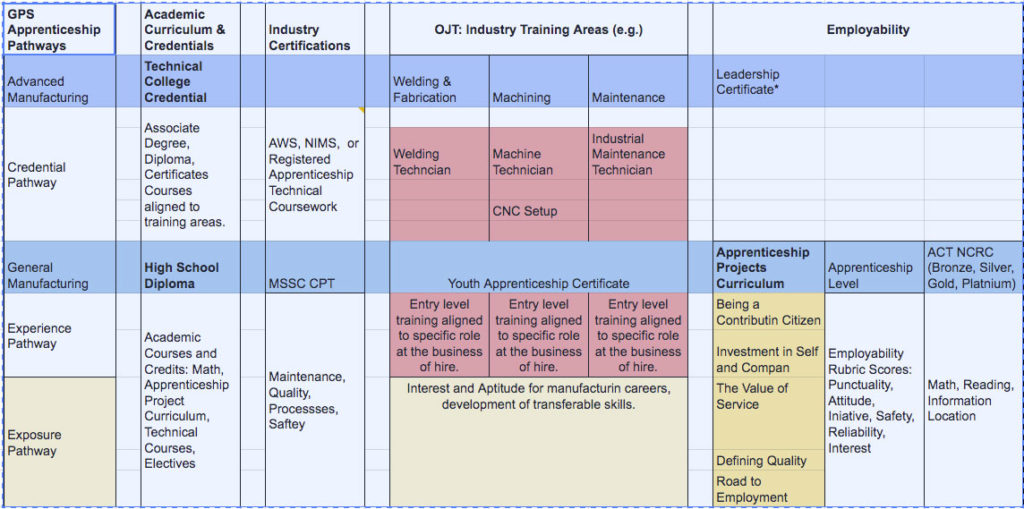
visual-of-education-training-alignment

Copyright © 2026 · Outreach Pro On Genesis Framework · WordPress · Log in